Quick answer: Bulk mulch is less expensive only when its material savings exceed any extra delivery, handling and installation costs. Compare the same mulch specification and volume—not a truckload against an unspecified number of bags. Calculate how much additional mulch the beds need, then price both options through to the finished job.
1. Calculate the additional mulch you actually need
Start with the area receiving mulch and the additional depth required, not an automatic full-depth application over everything already there.
Use these purchasing calculations:
Cubic feet needed = bed area in square feet × additional depth in inches ÷ 12
Cubic yards needed = cubic feet ÷ 27
Bags needed = cubic feet ÷ labeled bag volume, rounded up to whole bags.
For example, 648 square feet receiving an additional 2 inches requires:
- 648 × 2 ÷ 12 = 108 cubic feet
- 108 ÷ 27 = 4 cubic yards
- 108 ÷ 2 = 54 two-cubic-foot bags
These are geometric purchasing quantities, not a recommendation to apply 2 inches everywhere. They assume an even layer over the measured area, without an extra allowance.
Before measuring, identify areas that will remain uncovered. Divide irregular beds into manageable rectangles and triangles, and record each separately. Avoid adding a blanket “waste percentage” without explaining what it covers; ask the supplier about order increments instead.
Choose the appropriate finished depth separately. University of Maryland Extension’s guidance for trees and shrubs recommends a shallow mulch layer of 1–3 inches and keeping mulch off tree bark. University of Minnesota Extension also advises monitoring existing depth and replenishing organic mulch as it decomposes. Neither approach supports repeatedly adding a full new layer without checking what remains. University of Maryland Extension. (extension.umn.edu)
2. Match the material before comparing prices
A cheap cubic yard is not necessarily an equivalent substitute for the bagged product you selected. Write a short material specification before requesting prices:
- Material: shredded hardwood blend, bark, pine nuggets or another identified product.
- Color: natural or color-enhanced.
- Texture: coarse chips, nuggets or a stated grind.
- Quantity: cubic yards or bags with a stated cubic-foot volume.
- Intended use: tree and shrub beds, perennial beds or another defined area.
Material suitability matters as much as packaging. Minnesota Extension identifies wood chips and shredded bark as options for trees, shrubs and perennial beds, while describing different uses for straw, compost and other mulches. Do not select an unsuitable material simply because its delivered volume is cheaper. (extension.umn.edu)
Normalize bag prices with:
Equivalent material price per cubic yard = bag price × 27 ÷ bag volume in cubic feet
One cubic yard equals 13.5 two-cubic-foot bags or nine three-cubic-foot bags. When purchasing, however, you must round the total order to whole bags.
Ask whether a quoted “bulk bag” means a large container holding a cubic yard or ordinary retail bags. Also request the actual bag count and volume for a pallet rather than treating “one pallet” as a standard quantity.
3. Worked example: equal volume in Cumming, Georgia
Illustrative purchasing budget—not a contractor quote. Location: Cumming/north metro Atlanta, Georgia, United States. Currency: USD. Checked November 29, 2026; the supplier’s price list was dated November 28, 2026.
Mulch Pros listed Hardwood Mulch Blend at $29.95 per cubic yard loose and $2.95 per two-cubic-foot bag. (mulchpros.com)
For the 648-square-foot example receiving an additional 2 inches:
| Purchasing option | Equal-volume material calculation | Material subtotal |
|---|---|---|
| Loose bulk, picked up | 4 cubic yards × $29.95 | $119.80 |
| Retail bags, picked up | 54 bags × $2.95 | $159.30 |
| Loose bulk, delivered | $119.80 + assumed $60 delivery | $179.80 |
The delivery assumption uses the supplier’s published $60 standard-truck minimum; actual charges depend on road mileage and truck selection. (mulchpros.com)
Result: Bulk saves $39.50 on material, but minimum-charge bulk delivery costs $20.50 more than bagged pickup. Exclusions: tax, pickup travel, vehicle costs, preparation, spreading and cleanup. Bagged delivery requires its own quote; it is not assumed free. Calculations use the published material prices above. (mulchpros.com)
The useful decision rule is:
Choose bulk when material savings exceed bulk’s additional nonmaterial costs.
Include pickup trips and your time if those matter to your decision. A comparison that values delivery but treats repeated collection trips as costless may not reflect your priorities.
4. Check delivery minimums and the unloading plan
A delivery minimum charge is different from a minimum order quantity. Ask about both, plus minimum purchase increments and the cost of a second trip.
For the Georgia supplier above, published terms distinguish loose dump-truck delivery from pallet delivery by flatbed and forklift. Standard-truck delivery has a $60 minimum; pallet delivery has a $100 minimum. Those are that supplier’s terms, not national benchmarks. (mulchpros.com)
Before placing an order, send the supplier a description or photographs of the proposed unloading location and ask it to approve the arrangement. Your checklist should include:
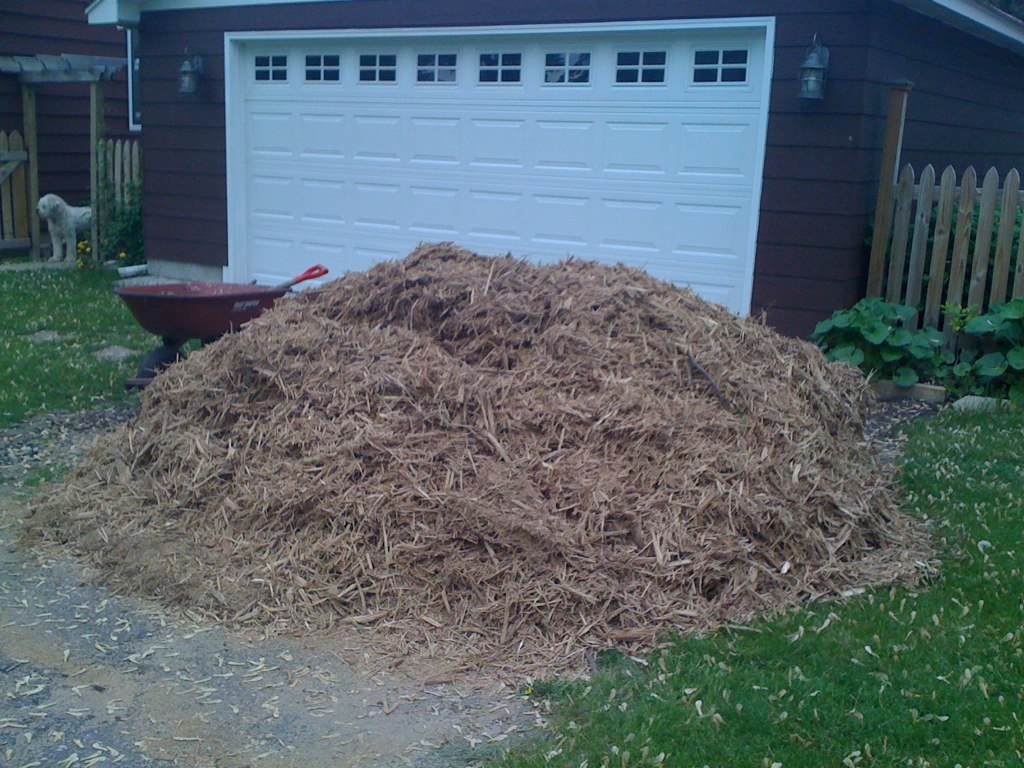
- Where the truck can stop and unload.
- Whether the price covers one drop or multiple drops.
- Gate, turning-space and overhead-clearance constraints.
- Surface restrictions and whether driveway protection is required.
- Whether the pile will block vehicles or necessary access.
- How material will move from the drop point to each bed.
- Charges if the driver cannot complete the planned delivery.
Do not assume a delivery truck can enter the backyard. The example supplier describes driveway or curbside pavement drops and lists truck-specific clearance requirements. Those requirements need confirmation for the actual vehicle and property; they are not universal safe-clearance rules. (mulchpros.com)
For your comparison, sketch the route from the unloading point to the beds. Include steps, slopes and narrow passages in the installation request rather than discovering an access disagreement after delivery.

5. Separate preparation, spreading and cleanup costs
“Mulch installation” needs a written definition. Ask each contractor to price the same scope:
| Scope item | What to establish |
|---|---|
| Bed preparation | Whether existing weeds and debris are removed |
| Existing mulch | Whether it stays, is redistributed or is removed |
| Edging | Whether edge work is included or separately priced |
| Material movement | Which beds and access routes the price covers |
| Application | Agreed additional depth and intended finished condition |
| Cleanup | Removal of empty bags, excess material and pavement debris |
| Extras | Approval process for work outside the original scope |
Removing weeds before application is consistent with Minnesota Extension guidance. But removal and disposal of all existing mulch should not be an automatic budget line: first assess its condition and remaining depth. (extension.umn.edu)
As a regional labor example, Mulch Pros published an installation charge of $38.95 per cubic yard, with a three-cubic-yard crew minimum and installation available with delivered material. At four cubic yards, that calculates to $155.80 for installation. It is not a nationwide labor rate, and the posted rate alone does not establish whether your preparation or access requirements are included. (mulchpros.com)
Request multiple written estimates describing the work, materials, completion timing and price. The Federal Trade Commission recommends that approach and cautions against automatically selecting the lowest bidder. (consumer.ftc.gov)
6. Budget replenishment from remaining depth, not the calendar
Separate the first installation from future maintenance purchases.
Organic mulch decomposes, so some replenishment may be needed. Minnesota Extension recommends monitoring depth and replenishing as decomposition occurs—not treating the original purchase quantity as a standing annual order. (extension.umn.edu)
Before requesting a refresh:
- Check several representative locations in each bed.
- Record the remaining mulch layer separately from the soil.
- Identify places needing redistribution rather than more material.
- Calculate any additional volume by bed.
- Recheck delivery and installation minimums for the smaller order.
For purchasing purposes, adding 1 inch over the example’s 648 square feet would require 2 cubic yards or 27 two-cubic-foot bags—half the original calculated quantity. Whether that addition is appropriate remains a plant- and site-specific question.
Ask maintenance contractors whether replenishment is based on measured need or a fixed quantity. Require approval before ordering extra material.
Keeping mulch away from trunks remains important during repeat visits. Maryland Extension warns against mulch touching bark and against excessive accumulation around trees and shrubs. University of Maryland Extension.
7. Avoid these mistakes before accepting a price
Comparing packages rather than volume. Record cubic feet per bag, bags per pallet and cubic yards of loose material. Recalculate all options against the same bed schedule.
Treating delivery as installation. Obtain separate descriptions of unloading, moving material into beds, spreading and cleanup. The example supplier explicitly distinguishes dropping a load from spreading it. (mulchpros.com)
Buying extra merely to meet a minimum. Compare the minimum-order total with bags or another supplier. Do not increase the application depth just to use the excess; overmulching can harm plants. University of Maryland Extension.
Assuming the lowest bid has the same scope. Ask the bidder to explain significant differences. Check applicable contractor licensing with the relevant state or county authority and request proof of insurance, consistent with FTC consumer guidance. (consumer.ftc.gov)
Before authorizing work, make sure the written estimate identifies:
- The beds and measured area.
- The specified material and purchased volume.
- Existing mulch treatment and additional application depth.
- Delivery method, unloading location and charges.
- Preparation, installation and cleanup inclusions.
- Taxes, minimums and exclusions.
- How additional work will be approved.
The cheapest practical option is the lowest comparable finished-job total—not necessarily the lowest advertised bag or cubic-yard price.
Read next: What Does a Landscape Maintenance Contract Actually Cover?